China Best Quartz Sink Manufacturers for Global Buyers?
Choosing the China Best quartz sink Manufacturers for Global Buyers requires more than comparing factory prices. A reliable supplier should prove material consistency, production experience, and export capability. Buyers should examine quartz content, resin quality, bowl thickness, surface finish, and drainage design. These details become visible when a sink meets boiling water, heavy cookware, and daily cleaning chemicals.
Kitchen designer Susan Serra, CKD, describes the sink as “the workhorse of the kitchen.” Her observation matters here. A quartz sink is not merely a decorative basin. It faces constant impact, moisture, heat, and abrasive use. Strong Chinese manufacturers usually support their claims with factory audits, product samples, inspection records, and clear warranty terms. Look for certifications relevant to the destination market. Confirm whether testing covers stain resistance, thermal shock, load strength, and color stability.
Good communication also separates dependable factories from attractive websites. Ask for exact dimensions, cutout templates, packaging photos, lead times, and replacement procedures. Request a sample before placing a container order. The sample may reveal uneven coloring, sharp edges, or weak packaging. Small flaws become expensive at scale.
No supplier is perfect. Even experienced exporters can miss a specification or underestimate transit damage. That is why written approvals and pre-shipment inspections remain necessary. This guide examines capable quartz sink manufacturers in China through a buyer’s practical lens. It considers manufacturing depth, customization, quality controls, pricing, logistics, and after-sales support. The best partner is not always the cheapest one. It is the factory that can repeatedly deliver the same sink, to the same specification, across different markets.
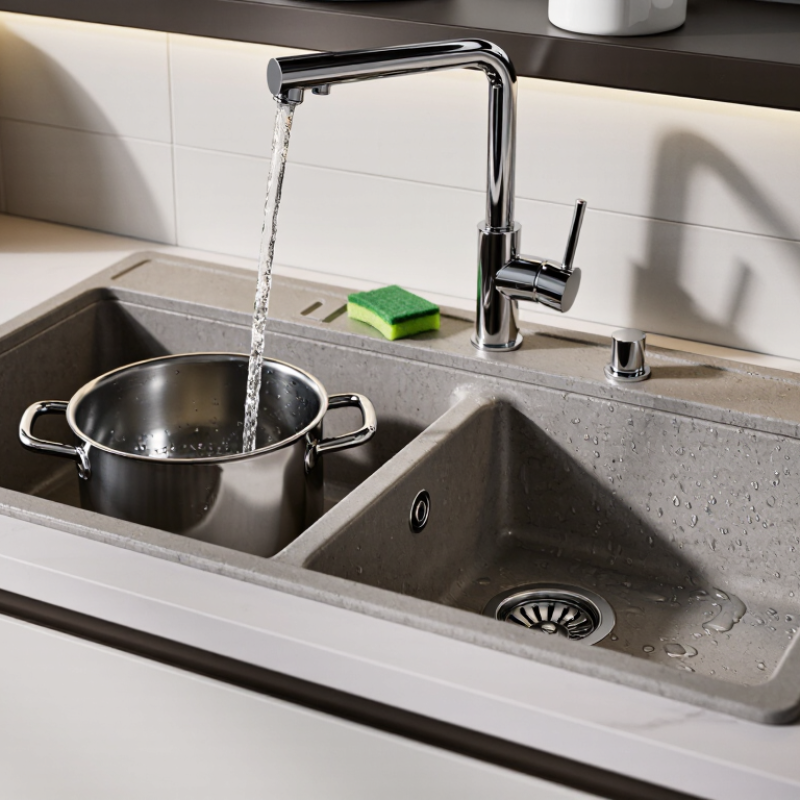
What Makes China a Leading Source of Quartz Sinks?
China has become a leading source of quartz sinks because it combines material access, dense manufacturing clusters, and flexible production. Grand View Research valued the global engineered stone market at about USD 30 billion in 2023, with continued growth expected through 2030. Quartz sinks benefit from this wider investment in engineered surfaces.
Manufacturers can produce single-bowl, double-bowl, and workstation designs with consistent molds. Many factories also support custom colors, drain positions, and packaging for overseas projects. The China Household Electrical Appliances Association reports that Chinese kitchen-related manufacturing benefits from mature domestic supply chains. This reduces lead times for resin, quartz powder, cartons, and stainless fittings. Quality is more measurable now. Buyers can request water-absorption tests, impact testing, dimensional reports, and batch photographs.
The picture is not perfect. Some suppliers still prioritize low prices over long-term durability. Color variation may appear between production batches. That detail matters.
Tips: Ask for a recent test report, not an old certificate. Confirm quartz content, sink thickness, drain size, and warranty terms in writing. Request a physical sample before approving mass production. Inspect the underside, corners, and overflow area carefully. A polished surface can hide weak reinforcement. Independent pre-shipment inspection adds cost, but it often prevents expensive replacement claims. Comparing three factories is useful, although the cheapest quotation may signal thinner material or weaker quality control.
How to Evaluate China’s Quartz Sink Manufacturers
Evaluating China’s quartz sink manufacturers requires more than comparing online prices. Start with the factory, not the sales brochure. Request a recent production video, workshop address, and clear ownership details. During a visit, inspect slab storage, molding lines, polishing stations, and packing areas. Clean floors matter, but process records matter more. Ask how workers control quartz content, resin ratios, curing time, and edge thickness. These details show whether quality depends on individual skill or repeatable systems. An attractive sample proves very little.
Check the material specifications and test documentation carefully. Reliable suppliers should provide water absorption results, load tests, temperature-resistance data, and applicable market compliance records. Confirm that reports come from an independent laboratory and match the exact model. Inspect drain openings, overflow fittings, clips, and carton protection. Small defects often appear after installation, not during inspection. Request samples from several production batches. Samples can mislead. Ask about mold tooling, replacement parts, lead times, and complaint handling. A dependable manufacturer explains limitations instead of promising zero defects.
Communication is another quality signal. Use a written specification with dimensions, color tolerance, packaging photos, inspection points, and agreed remedies. Check export experience through verifiable references, not copied testimonials. Factories may offer low minimum orders, yet customization can create hidden tooling costs. Calculate landed costs, including sampling, freight, duties, breakage risk, and after-sales support. Ideally, use pre-shipment inspection. Still, no audit catches everything. Do not guess. That uncomfortable fact should influence payment terms, warranty wording, and contingency stock.
How Global Buyers Can Compare Prices, Services, and Capabilities
Global buyers should compare quartz sink suppliers through evidence, not catalog language. Grand View Research valued the global engineered stone market at about USD 24.5 billion in 2022, with continued growth expected through 2030. That growth attracts capable factories and weaker imitators. A low quote can still be expensive.
Request a complete landed-cost sheet. It should include the sink, packaging, tooling, inspection, freight, insurance, and import charges. Compare identical specifications, including bowl size, thickness, radius, drain position, and color consistency. Ask for recent test records covering water absorption, heat resistance, impact strength, and stain performance. ASTM C373 is commonly used for water absorption testing, while ISO 9001 certification can indicate controlled production systems. Certification alone is not proof. Verify its scope and validity.
Service capability matters after payment. Ask about drawing approval, sample timing, replacement procedures, spare units, and response times. Suppliers should provide packing photos and loading records. Experienced buyers also inspect random cartons before shipment. A factory audit should review mixing, molding, curing, polishing, and final inspection. Production capacity needs evidence, such as monthly output, equipment lists, and staff coverage. Be careful with impressive numbers. They may describe total factory capacity, not quartz sink capacity. In my view, a weighted scorecard is safer than choosing the lowest price: product quality, delivery reliability, technical service, communication, and total cost should each receive a clear score. Allow room for doubt. Mistakes happen.
China Best Quartz Sink Manufacturers for Global Buyers
How global buyers can compare prices, services, and manufacturing capabilities
This neutral benchmark uses measurable sourcing factors commonly reviewed by international buyers. Higher scores indicate stronger purchasing value, combining competitive pricing, production capacity, quality control, export services, customization, and delivery performance. Buyers should verify each figure through quotations, factory audits, samples, and certification documents.
What to Know About Ordering Quartz Sinks from China
Ordering quartz sinks from China requires more than comparing unit prices. Grand View Research estimates the global kitchen sinks market was worth about US$3.4 billion in 2023, with steady growth expected through 2030. This expansion attracts many factories, but quality varies sharply. Ask for recent test reports, production photos, material specifications, and a physical sample. Confirm quartz content, resin type, bowl depth, drain position, and color tolerance before placing a large order. A sample may look perfect under showroom lighting. Inspect it beside a window.
Factory experience matters. During supplier evaluations, I would check mold condition, edge finishing, curing controls, and packaging strength. Request a written inspection standard, including surface defects, dimensional limits, and water-drainage performance. ISO 9001 certification can support process control, but it does not guarantee every shipment. The International Trade Centre’s trade data also shows how global home-fixture sourcing depends on accurate product classification and customs documentation. Confirm the correct tariff code with a qualified broker. Small errors can delay containers.
Use reinforced cartons, corner protection, and moisture-resistant wrapping. Ask for carton drop-test evidence, especially for thin-edged models. Incoterms, payment stages, lead time, replacement rules, and inspection costs should appear in the purchase contract. I would not rely on factory promises alone. Some buyers, including experienced ones, overlook color variation between batches. That mistake is expensive. A pre-shipment inspection and retained sample create useful evidence when disputes arise.